


In today's fast-paced markets, rapidly changing technologies and economic challenges, we need effective growth strategies to help the company navigate and drive better results. One of the most popular tools for strategic planning is the Ansoff matrix, created by Harry Igor Ansoff in 1957. In this article, we will look at the history of the matrix, when and how companies can use it, what benefits it can bring, and what its key dimensions and strategies are.
Ansoff Matrix in short
Harry Igor Ansoff, a Russian-born American mathematician and businessman, created his matrix as part of his strategic approach to management. First published in his book Corporate Strategy in 1957, Ansoff's matrix has established itself as one of the most important strategic planning tools, providing a framework for analyzing various growth opportunities.
When can the matrix be used by the company?
Ansoff's matrix is useful in any phase of the business cycle when a company wants to assess its growth opportunities. It can be used for:
• Entering new markets.
• Launch of new products.
• Exploring opportunities to expand into existing markets.
• Strategic planning and risk assessment.
Benefits of using the Ansoff matrix
The Ansoff Matrix helps companies to:
+ Identify potential growth opportunities.
+ Develop clear and coherent strategies.
+ Evaluate the risks associated with different strategies.
+ Make informed decisions about the future of their business.
Dimensions of the Ansoff Matrix
Ansoff's matrix is built on two main dimensions:
1. Products (existing and new);
2. Markets (existing and new).
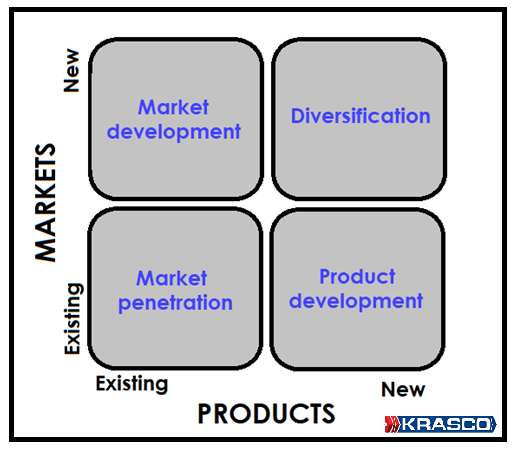
THE FOUR STRATEGIES TO INCREASE REVENUE AND PRODUCTION:
1. Market penetration
This is the most reliable strategy. With it, the company is aware of the situation and focuses on increasing the sales of Existing Products in Existing Markets. The idea of market penetration is for a firm to sell more of the same things to the same customers. This can be achieved by:
- Improve its internal efficiency and improve its products or services;
- Improve the effectiveness of the sales team (for example, through sales training);
- Developed a new marketing campaign to encourage more people to buy, try and use its products.
2. Market development
This strategy involves offering Existing Products in New Markets. The idea of market development is to sell the same thing to new customers. Here the company can:
- To focus on new geographic markets - domestic or international;
- To reposition its products or find new channels for their distribution. For example, from physical sales to move to online sales;
- To try to conquer new segments of the market.
3. Product development
This strategy consists of offering New Products for Existing Markets. The idea of product development is for the company to sell new things to existing customers. In this regard, the company may:
- To develop/add complementary products that combine well with the core products;
- To improve key aspects of the product such as quality, service and time to move from production to market;
- To innovate and expand its product range by offering its products in new variants or different packaging.
4. Diversification
The riskiest strategy, diversification, involves creating New Products for New Markets. This can represent a completely new activity for the company, both in terms of products and in terms of marketing. In such a case, the firm will have greater difficulty in using its know-how or in initially extracting certain economies of scale. She can be:
- Related (when new products are related to current business).
- Unrelated (when new products have nothing to do with current business).
STEPS TO WRITE DOWN EACH OF THE FOUR STRATEGIES FOR YOU COMPANY:
1. In the "Market Penetration" area:
- Assess current market shares;
- Explore opportunities to increase sales of existing products in current markets through marketing campaigns, promotions and improving customer service.
2. In the "Market Development" area:
- Identify new market segments or geographic regions that may be interested in your existing products;
- Analyze the needs and preferences of potential new markets.
3. In the "Product Development" area:
- Evaluate current products and market needs;
- Explore opportunities to develop new products or improve existing ones for current markets.
4. In the "Diversification" area:
- Identify new product development opportunities for new markets
- Evaluate the risks and benefits of entering new industries or areas of business.
In summary
The Ansoff Matrix is a powerful strategic planning tool that helps your company analyze the opportunities and risks of various growth and development strategies. It provides four main options for action, and all strategies can be useful, with varying degrees of risk and potential returns.
KRASCO
Did you like the article?
Please rate it with the stars below.